
Emergency lighting ensures that people can safely leave a building even in the event of a power failure or fire. It illuminates escape and rescue routes, reduces the risk of accidents and helps emergency services to find their way around. It is not only a sensible safety measure – it is also required by law in many buildings.
Why is emergency lighting so important?
When general lighting fails, uncertainty quickly arises. This can have fatal consequences, especially in large buildings such as production facilities, hospitals or meeting places. Functioning emergency lighting:
- ensures the safe use of escape routes
- prevents panic and falls
- enables rapid evacuation
- supports fire and rescue services
The responsibility lies with the building operator or employer.
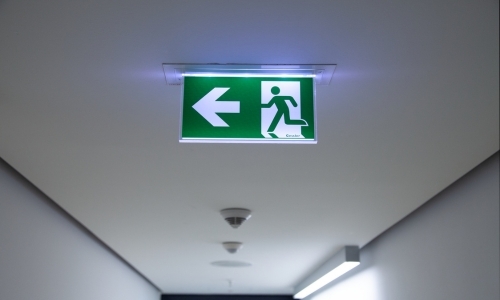
Emergency lighting: These regulations apply in Germany
The planning and operation of emergency lighting are subject to clear legal requirements. The most important standards and regulations include:
| DIN EN 1838 specifies the requirements for emergency lighting. Among other things, it defines minimum illuminance levels on escape routes, requirements for anti-panic lighting and the marking of emergency exits. | The ArbStättV obliges employers to provide adequate safety lighting if hazards could arise in the event of a failure of the general lighting. In addition, the Technical Rules for Workplaces apply. | DIN VDE 0108 regulates the professional installation of emergency lighting systems. It describes requirements for power sources, cable routing and monitoring systems. In addition, regular inspections by experts are mandatory. |
Types of emergency lighting
Different systems are used depending on the size and use of the building.
Single battery systems are generally used for emergency exit signs and safety lights. Each light has an integrated rechargeable battery.
They are particularly suitable for smaller properties or individual areas of buildings. | In a central battery system (CPS system), several luminaires are supplied via a central power source.
This solution is economical for larger buildings with many luminaires. | Group battery systems (LPS systems) supply emergency lighting in a decentralised manner within a fire compartment.
They offer a flexible solution for complex building structures. |
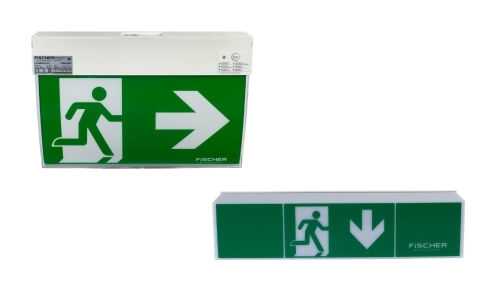
Installation and maintenance of emergency lighting
Emergency lighting may only be installed by qualified specialists. Careful planning ensures that:
- all escape routes are illuminated in accordance with standards
- emergency signs are positioned correctly
- the power supply is redundantly secured
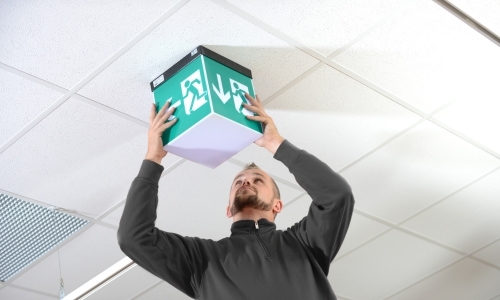
Regular testing is equally important. Emergency lighting systems must be tested at least once a year. In addition, a comprehensive expert inspection in accordance with DIN VDE 0108 is required at specified intervals. The results must be documented in a test log and kept for at least four years.
With a maintenance contract, CWS Fire Safety takes care of the following for you:
- Regular visual and functional inspections
- Documentation in accordance with VDE specifications
- Legally compliant maintenance

Emergency lighting protects!
Standard-compliant emergency lighting is essential for safety in buildings. It meets legal requirements, minimises liability risks and saves lives in an emergency.
Whether a single battery system, central battery system or group battery system – the right solution depends on the type of building, its use and risk assessment.
Let our experts advise you. Together, we will develop a tailor-made safety concept for your property.