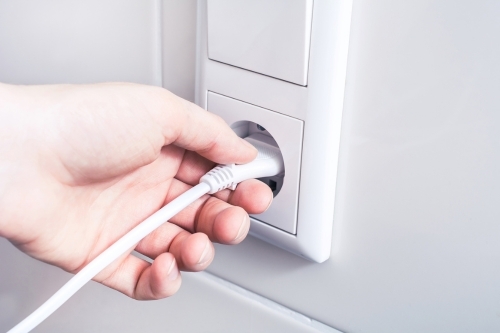
Multiple sockets are part of everyday life today - in private households as well as in businesses. They create flexibility by allowing several electrical devices to be operated at the same time. However, this also poses a serious risk: an overload can quickly lead to dangerous situations.
Fire hazard from multiple sockets
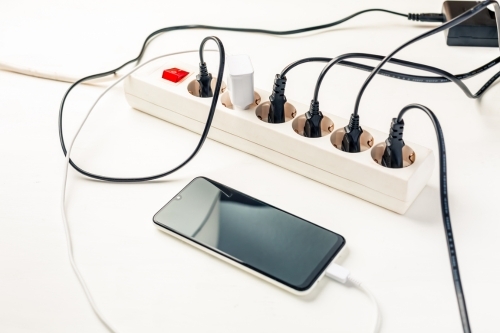
Most commercially available socket strips are designed for a maximum load of 3,500 watts. If several devices with high power consumption are connected at the same time or several strips are plugged in one after the other, this limit can be exceeded unnoticed.
Consequences of an overloaded multiple socket
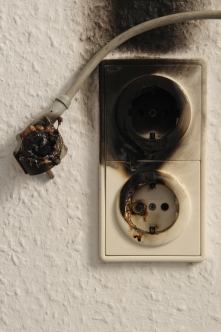
An overloaded multiple socket outlet can overheat, resulting in short circuits, smouldering fires or, in the worst case, an extensive cable fire. Such fires not only cause considerable damage to property, but also endanger human life. It is therefore crucial to know the power limits and adapt the use of electrical appliances accordingly.
Typical power consumers at a glance
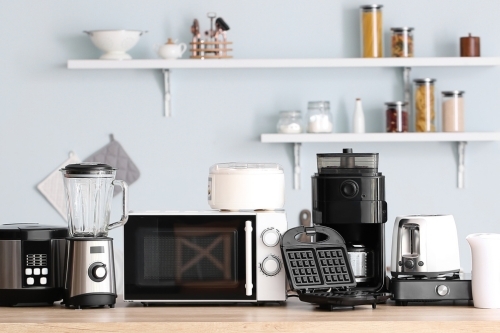
A look at the power consumption of common household appliances quickly shows how quickly the permissible total output can be exceeded.
- Coffee maker: 850 - 1,200 watts
- Fully automatic coffee maker: 1,500 watts
- Electric kettle: 1,500 - 2,400 watts
- Iron: 2,000 - 3,200 watts
- Toaster: 700 - 1,600 watts
- Microwave: 700 - 1,500 watts
- Washing machine / dryer: 1,500 - 3,000 watts
Example: If a kettle with 2,400 watts and a fully automatic coffee machine with 1,500 watts are operated simultaneously on a power strip, the load adds up to 3,900 watts - far above the permissible limit.
This example shows how important it is to be aware of the power consumption of your own appliances and to consciously control the load. Particularly in kitchens, offices or workshops, where several appliances are used in parallel, targeted planning of power distribution is essential.
Tips for the safe use of multiple sockets
If you want to use multiple sockets safely, you should pay attention to tested quality. Products with the CE, GS, VDE or TÜV mark generally offer reliable protection. Responsible everyday use is just as important. This includes never connecting several power strips in series, as this significantly increases the risk of fire. Power strips should also not be hidden behind furniture or under carpets, where heat can build up.
We recommend a regular visual inspection for damaged cables or scorched contacts before using the appliance. Appliances that are not in use should be unplugged from the socket - not only for safety reasons, but also to avoid unnecessary standby consumption.
Fire protection tips for socket outlets at a glance:
- Choose tested quality: Look for the CE, GS, VDE or TÜV mark.
- No cascading: Never connect several multiple socket strips in series.
- Ensure free placement: No covering by carpets or furniture.
- Regular visual inspection: Check cables and contacts for damage.
- Unplug appliances when not in use: Increase safety and save electricity.
- Connect powerful devices directly: Only operate via permanently installed wall sockets.
What to do in case of danger?
If an incident occurs despite all precautions, every second counts. First of all, the power supply should be disconnected, either by pulling the plug or switching off the relevant fuse circuit. Smaller fires can usually be contained with a suitable fire extinguisher - such as CO₂, powder or fluorine-free foam. In the event of an uncontrolled fire, the fire department should be alerted immediately by calling 112.
It is equally important to behave correctly in the building: get yourself and other people to safety, close doors to slow the spread of smoke and flames and do not attempt to extinguish the fire if this would endanger your own safety.