
Firefighting foam containing PFAS has long been an indispensable tool for fighting fires—especially liquid fires, such as those in the chemical industry, at airports, or in refineries. It is highly effective because it quickly smothers the source of the fire and prevents reignition.
However, PFAS (per- and polyfluoroalkyl substances), which give the firefighting foam its water-, grease-, and dirt-repellent properties, are increasingly coming under criticism.
What is PFAS firefighting foam and how does it work?
PFAS firefighting foam consists of synthetic foaming agents that contain fluorinated hydrocarbons. These substances reduce the surface tension of the foam, allowing it to quickly cover burning liquids and form a smothering layer.
The special chemical structure of PFAS makes them extremely stable—an advantage in the event of a fire, but a significant problem for the environment and health.

Why is PFAS firefighting foam the focus of discussion?
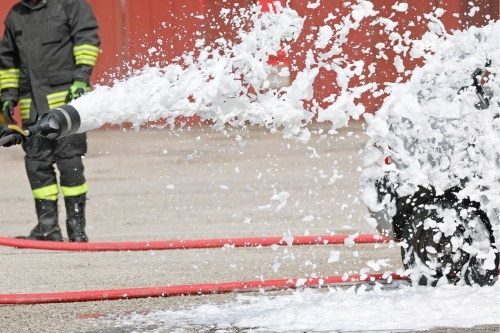
Criticism of PFAS is based on their high environmental persistence: once released, PFAS hardly degrade. They enter the groundwater, accumulate in organisms, and are considered potentially harmful to health. Studies point to possible links with cancer, hormonal disorders, and immunological effects.
Against this background, the European Chemicals Agency (ECHA) has developed proposals for a comprehensive ban on PFAS in numerous areas of application, including fire extinguishing agents.
PFAS ban affects many businesses
Need for action grows
The planned EU-wide ban on PFAS affects not only manufacturers, but also operators of fire extinguishers and extinguishing systems that use PFAS-containing foam. This regulation therefore affects a large number of companies – from industrial operations to public institutions.
Important: PFAS foam extinguishing agents may no longer be used or refilled in the future. Companies that still use PFAS-containing fire extinguishers should act early:
- Inventory of existing equipment
- Risk assessment
- Switch to fluorine-free alternatives
- Proper disposal of old extinguishing agents

Act now and take responsibility

Responsible use of PFAS in fire protection is not only a legal requirement, but also contributes to environmental and health protection.
CWS Fire Safety supports you with tested, fluorine-free fire extinguishers and comprehensive advice on converting your fire protection system.