
Fires pose a serious risk to people, the environment and property. It is therefore crucial to fight them with suitable extinguishing agents. The choice of the right agent depends on the type of combustible material - the so-called fire class.
In this article, we provide a comprehensive overview of the common extinguishing agents and explain their specific areas of application in fire extinguishers and extinguishing systems.
The fire classes as a basis for selection
The fire classes are the basis of all firefighting. Fires involving solid materials such as wood, paper or textiles belong to fire class A, while fire class B includes liquid or liquefying materials such as petrol or alcohol.
Gas fires are assigned to fire class C, while fire class D refers to metal fires. Finally, there is fire class F for grease and oil fires in kitchens. The various extinguishing agents are each suitable for one or more of these fire classes.
Extinguishing agents in fire extinguishers
Small helpers with a big impact
Fire extinguishers are indispensable tools for fighting fires in their early stages.
Water as an extinguishing agent
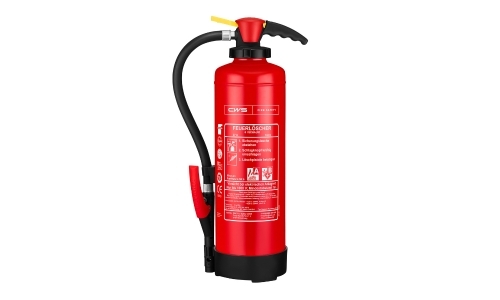
Water is the simplest and most effective extinguishing agent for class A fires. It cools the burning material and thus prevents the fire from spreading further. Water extinguishers are often found in offices, schools and public buildings, as these mainly contain solid materials such as paper or textiles.
However, water is unsuitable for class B, C, D and F fires, as it can cause dangerous explosions in grease fires, for example.
Foam as an extinguishing agent
Foam is often used for class A and B fires. This extinguishing agent smothers the fire by cutting off the oxygen supply and at the same time provides a cooling effect.
Foam is the preferred choice, particularly in industry, at filling stations and in vehicles, where liquid fuels are often involved. Foam also provides valuable services in large warehouses with mixed goods, as it is versatile.
Powder as an extinguishing agent
Powder is one of the most universal extinguishing agents and is suitable for fire classes A, B and C, and in some cases also for class D metal fires. It works by interrupting the chemical reaction of the fire.
Powder extinguishers are widely used, for example in households, workshops or vehicles, as they are versatile and comparatively inexpensive. In metal processing, where magnesium or aluminum can burn, special powders are also used that are suitable for such demanding fires.
The disadvantage of powder, however, is that it leaves behind residues that can damage sensitive electronics or machinery.
CO2 as an extinguishing agent
Carbon dioxide is a residue-free extinguishing agent that is used particularly in the electronics and IT industries. It is suitable for fire classes B and C and extinguishes by displacing the oxygen required by the fire.
In data centers, museums or laboratories where sensitive equipment and valuable objects need to be protected, CO2 is the preferred choice as an extinguishing agent.
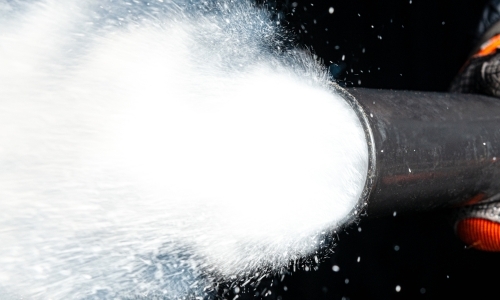
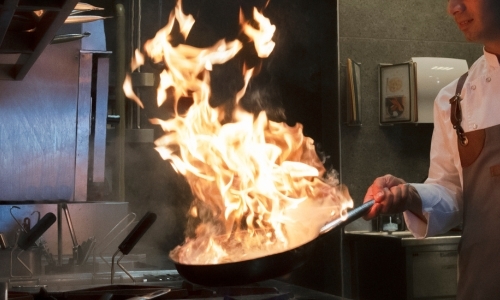
Another special extinguishing agent is the grease fire extinguisher, which was developed for fire class F. These extinguishers contain a special liquid that forms a soapy layer on contact with burning oils or fats, which smothers the fire.
They are indispensable in commercial kitchens, restaurants and food processing plants, where grease fires are one of the most common causes of fire.

The range of extinguishing agents is just as diverse as the fire hazards themselves. Whether water, foam, powder, CO2 or special solutions for grease fires - each extinguishing agent has its strengths and specific areas of application. While fire extinguishers are indispensable for initial firefighting, extinguishing systems offer large-scale and often automated protection in particularly high-risk areas.
Choosing the right extinguishing agent is not only a technical decision, but also an economic and safety-related one. Investing in suitable extinguishing systems not only protects assets, but also saves lives in an emergency.