
Whether shoes, baby carriages, bicycles or decorations outside the front door. Time and again, there is increased annoyance in apartment buildings because the neighbor uses the shared stairwell as a storage place for personal belongings. Fire protection in the stairwell also plays a decisive role here.
Why is fire protection important in the stairwell?
In general:
The residents of an apartment building are entitled to make use of the rented property itself or the common property. This also includes the use of the common stairwell.
Nevertheless, there is the important principle that a stairwell must be safe for use. They must be kept clear at all times so as not to make it difficult for emergency services (e.g. the police, paramedics, emergency doctors or the fire department) to work in an emergency situation. In addition, hallways and stairwells are considered the first escape and rescue routes in the event of a fire. They should not be blocked by objects (e.g. furniture, decorations or bicycles). In addition, it is important to keep the fire load in the stairwell as low as possible to ensure the safety of the occupants in the event of a fire.

Regulations for fire protection in the stairwell
In Germany, there are currently no uniform regulations for fire protection in stairwells. However, there are state-specific fire protection regulations that define what fire protection in the stairwell must look like. In addition, the state building codes require the fire load in the stairwell to be as low as possible, since the stairwell usually also represents the first escape and rescue route. At the same time, care must be taken to ensure that the minimum width of the corridors is not narrowed by objects. This is particularly important since the escape route is also always an attack route for the fire department in the event of a fire and for the rescue service in the event of a medical emergency.
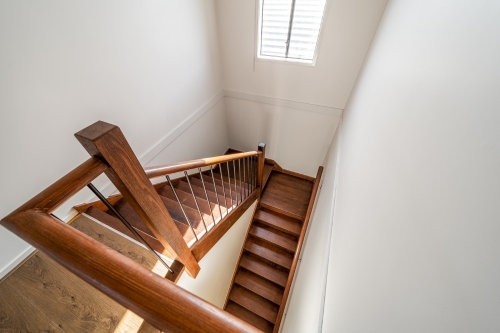
Ensuring safety as a tenant
In principle, the landlord of an apartment building is responsible for the general safety in the stairwell. Thus, he may decide what his tenants are allowed to do and what not. Usually, this is also regulated in the house rules or in the rental agreement.
However, the landlord's task is also to ensure at all times that potential hazards in the stairwell are eliminated and that any associated accidents can be avoided. At the same time, he is responsible for fire protection in the stairwell. This means that he must ensure that escape and rescue routes are marked and unobstructed and that the fire load in the stairwell is as low as possible. This also includes, among other things, functioning safety lighting in the stairwell. This ensures that the occupants can find their way around and leave the building quickly even in the event of a fire.
In summary, the best option is to keep the stairwell completely free of possible objects and commodes. Only in this way it is possible to ensure maximum safety in case of fire with a strong smoke development.
However, it is possible to place objects in the hallway as long as they do not interfere with or obstruct the escape and rescue routes in any way. However, the landlord is responsible for fire protection and safety, which is why the house rules should be posted by the landlord in a place accessible to every occupant of his building and should also be recorded in the individual rental agreements. The instructions of the house rules by the tenant must always be followed.