Ban on fluorinated foam extinguishing products
Fluorine-containing foam extinguishing agents will be banned from 2026. Find out more about handling fire extinguishers containing fluorine.
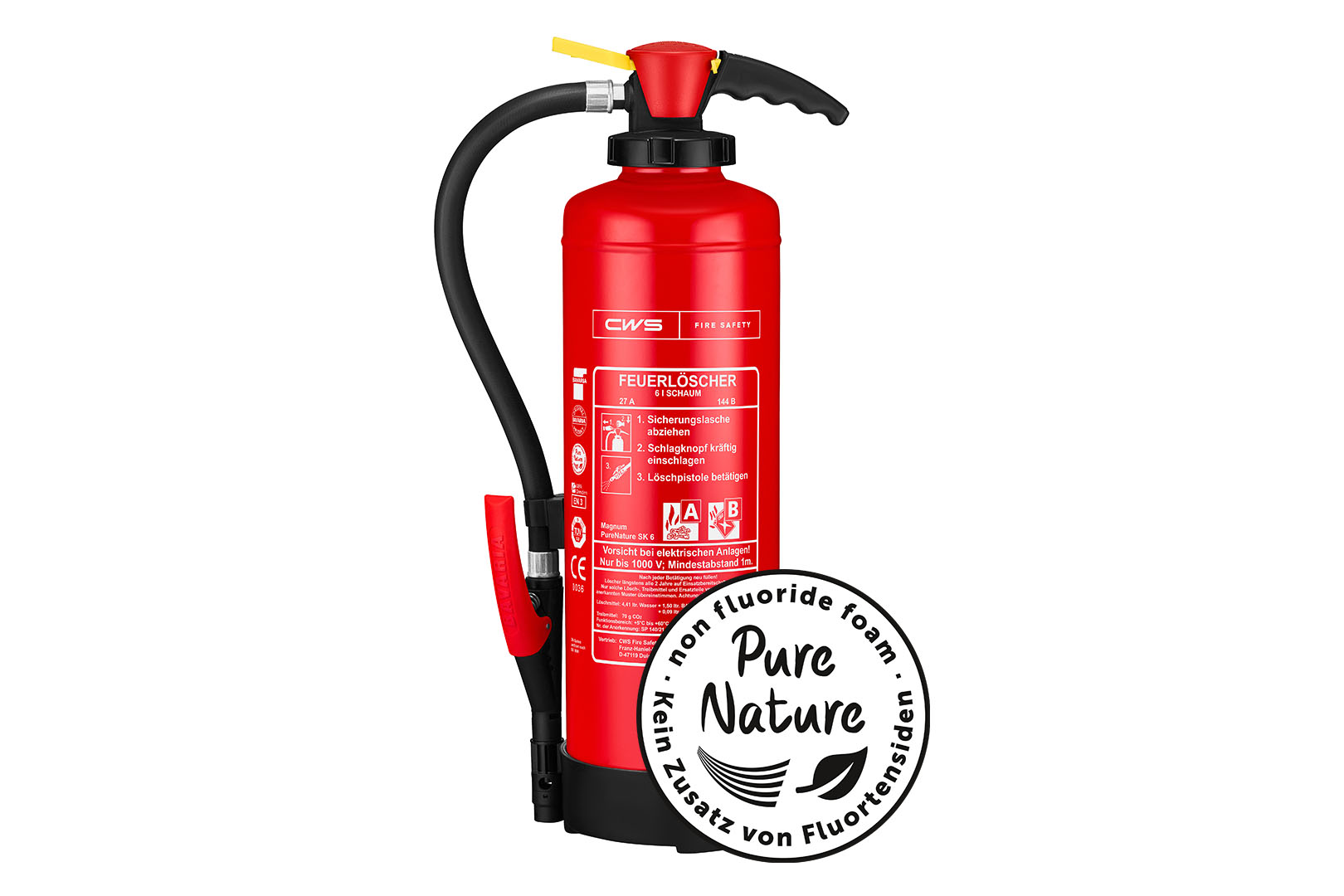
Previous foam fire extinguishers contain a fluorine-containing foam extinguishing agent, which is harmful to the environment and very difficult to biodegrade.
An EU ban on fluorine-containing foam extinguishing agents will apply from 2026. An early switch to fluorine-free fire extinguishers is recommended to ensure an economical transition. Learn more about:
- EU fluorine ban
- Fluorine-free alternatives from CWS
- Frequently asked questions and answers about fluorinated fire extinguishers
CWS supports you on your way to a fluorine-free future
Ban on fluorinated foam agents
The European Chemicals Agency (ECHA) has defined a Europe-wide ban on foam fire extinguishers containing per- and polyfluorinated alkyl substances (PFAS for short). The background to the fluorine ban is that perfluorinated and polyfluorinated chemicals are harmful to human health and the environment. For example, a fluorine ban will soon apply, which will prevent the use of foam extinguishing agents containing fluorine.
From 2026, a ban on fire extinguishers containing fluorine will (gradually) come into force. Early action is therefore necessary in order to meet the requirements in good time and also to ensure an economical transition in your company.
It is advisable to replace fire extinguishers containing fluorine during the current test cycle so that you only have fluorine-free foam fire extinguishers in use once the fluorine ban comes into force. At the same time, it is no longer possible to replace extinguishing agents in fluorine-containing fire extinguishers, as the “old” extinguishing agent is no longer available.
Do you have questions about handling fluorinated foam fire extinguishers?
Click here and get answers to the most frequently asked questions.
EU ban on fluorinated foam extinguishing agents at a glance:
- From October 23, 2026, fire extinguishers containing PFAS may no longer be sold.
- Their use is expected to be completely banned from 2031.
- Restrictions apply during the transition periods for fire extinguishers containing fluorine. The use of fluorine-containing fire extinguishers is only permitted for fire class B, but not for fire class A. Without timely replacement, the contractor must prepare a new risk assessment.

- Extinguishing agent replacement for old foam extinguishers is already no longer possible.
- Conversion is often not economical or not possible at all. Individual testing is necessary.
We recommend replacing fluorine-containing fire extinguishers now to ensure an economical transition!
Use fluorine-free fire extinguishers now.
Your way to a fluorine-free future with CWS.
We support you with a wide range of fluorine-free foam fire extinguishers that completely dispense with poly/perfluorinated chemicals and comply with current European regulations. Despite the absence of fluorine compounds, our fluorine-free fire extinguishers are highly effective and reliable in an emergency. Various versions are available, for example with a firing head fitting or manual lever release, so that you can find the right solution for every application.
We recommend that you switch to fluorine-free alternatives at an early stage - for greater sustainability, legal certainty and an economically viable transition to a fluorine-free future for your company.
Your advantages to act now
- Economical transition: Integrate the replacement into your budget planning in good time. Replace fluorine-containing fire extinguishers during maintenance and save additional travel costs. You also avoid high disposal costs and supply bottlenecks by replacing your old devices early.
- Maintain insurance cover: Modern, fluorine-free extinguishers are a prerequisite for full insurance cover. This means that PFAS damage is increasingly excluded.
- Legally protected: Meet the EU requirements for foam extinguishing agents on time. Future violations of PFAS regulations can be prosecuted - act now!
- Strengthen sustainability in your company
FAQ
Fluorinated fire extinguishers & foam extinguishing agents
We provide answers to the most frequently asked questions about the EU ban on fluorinated fire extinguishers, fluorinated foam extinguishing agents and the impact on your business.
When does the ban on fire extinguishers containing fluorine apply?
+
−
The ban on fluorine-containing foam concentrates, including fluorine-containing fire extinguishers, will come into force from 2026. The following deadlines apply:
- From April 23, 2027, the use of fire extinguishers containing PFAS for training purposes and by public fire departments will no longer be permitted.
- From October 23, 2026, fire extinguishers containing PFAS may no longer be placed on the market.
- Until 2030, PFAS fire extinguishers manufactured before the deadline may be used with restrictions under a transitional arrangement.
An immediate switch to fluorine-free alternatives is recommended to ensure an economically viable implementation for your business.
In addition, the extinguishing agent for existing foam extinguishers is no longer available due to the upcoming EU ban on fire extinguishing agents containing fluorine, as production has already been discontinued. A complete replacement with fluorine-free fire extinguishers is therefore unavoidable when replacing extinguishing agents. Retrofitting existing equipment can be examined, but requires an assessment of feasibility and cost-effectiveness. During the transition period, the use of fluorine-containing fire extinguishers will only be permitted for fire class B, but not for fire class A.
Why is fluorinated foam extinguishing agent banned?
+
−
Fluorine is a chemical element and particularly reactive. As a result, fluorine has so far been used in foam extinguishing agents to achieve a fast extinguishing performance. However, the perfluorinated and polyfluorinated alkyl substances (PFAS for short) contained in the extinguishing foam are harmful to the environment. Thus, the concentration in foam extinguishing agents containing fluorine has already been limited (max. 0.04 %).
However, this limit is no longer sufficient to fully protect humans and the environment. Consequently, the ECHA is planning a complete ban on fluorine-containing foam extinguishing agents.
Who is responsible for switching to fluorine-free foam fire extinguishers?
+
−
Switching from fluorine-containing foam fire extinguishers to fluorine-free foam fire extinguishers is the responsibility of building operators and employers.
How quickly must the changeover from fluorine-containing fire extinguishers to fluorine-free alternatives take place?
+
−
The switch to fluorine-free foam fire extinguishers must be made within a transition period (probably 5 years). Therefore, it is recommended to plan for the replacement to fluorine-free foam fire extinguishers and to already gradually switch to fluorine-free foam fire extinguishers.
Is a conversion also possible?
+
−
Conversion from a fluorine-containing foam fire extinguisher to a fluorine-free foam fire extinguisher is possible, depending on the model type. However, this is not economical!
An economical conversion is only possible into a water fire extinguisher for fire class A. Conversion therefore only makes sense if only fires of fire class A are to be expected in the company.
Contact our experts. We will be happy to advise you on the conversion and replacement of fluorine-containing fire extinguishers with fluorine-free alternatives from CWS.
What advantages have foam fire extinguishers over other fire extinguishers?
+
−
Foam fire extinguishers are suitable for fire class A (wood, paper or textiles) and fire class B (oils, greases or paints). In parallel, foam fire extinguishers are very efficient compared to other wet extinguishing agents and ensure a quick extinguishing success. Furthermore, foam fire extinguishers cause little damage due to the foam agent used (especially compared to a powder fire extinguisher).
Are there differences in performance between fluorinated fire extinguishers and fluorine-free alternatives?
+
−
Compared to fluorine-free foam fire extinguishers, fluorine-containing fire extinguishers have a slightly higher extinguishing unit (LE). However, the extinguishing capacity of fluorine-free foam fire extinguishers is sufficient in standard applications. A change from fluorine-containing foam extinguishers to fluorine-free variants is therefore usually possible without any problems.
How to recognise fire extinguishers containing fluorine that are affected by the fluorine ban?
+
−
Fluorine-free foam extinguishers have labels stating that they contain fluorine-free foam extinguishing agent.
If you are unsure whether your fire extinguishers are affected by the fluorine ban, take a photo of the type plate of your foam fire extinguishers and send them to us at firesafety@cws.com.
Our experts will use the data to check whether they are fluorine-containing fire extinguishers affected by the Europe-wide ban on fluorine-containing foam agents.
Can alternative extinguishing agents also be used?
+
−
It is not possible to make a general statement as to whether alternative extinguishing agents are also possible in your company. However, we will be happy to check whether other extinguishing agents are also suitable, depending on the existing fire hazards.
What happens to decommissioned fluorinated fire extinguishers?
+
−
If the replacement of the fluorine-containing fire extinguishers is handled by us, we will dispose of your fluorine-containing foam fire extinguishers professionally.
Is the use of a fluorine-containing foam extinguishing agent dangerous?
+
−
No, there is no direct health hazard. However, it makes sense to replace fluorine-containing foam fire extinguishers soon, not only because of the fluorine ban in the EU, but also to protect the environment.
Strengthen sustainability in your business now and switch to fluorine-free foam extinguishers.
We support you in changing!
Would you like to start replacing your fluorine-containing fire extinguishers?
Contact us (ideally) with the following information:
- Number of foam fire extinguishers for fire classes A & B in your company.
- Size & extinguishing units of the foam fire extinguishers (preferably with a picture of the type designation)
Our regional experts will promptly provide you with a quotation and advise you in detail on the economic transition from fluorine-containing fire extinguishers to fluorine-free alternatives from CWS.